CJ Pukala
Blogs For Class
-

-

Currently, I am working on a long-form piece regarding the rising popularity of vintage sports apparel over the last few years. This week, I was tasked with creating short social posts to promote my piece, so I made graphics in Canva and used them in the posts. Here they are below.
Instagram
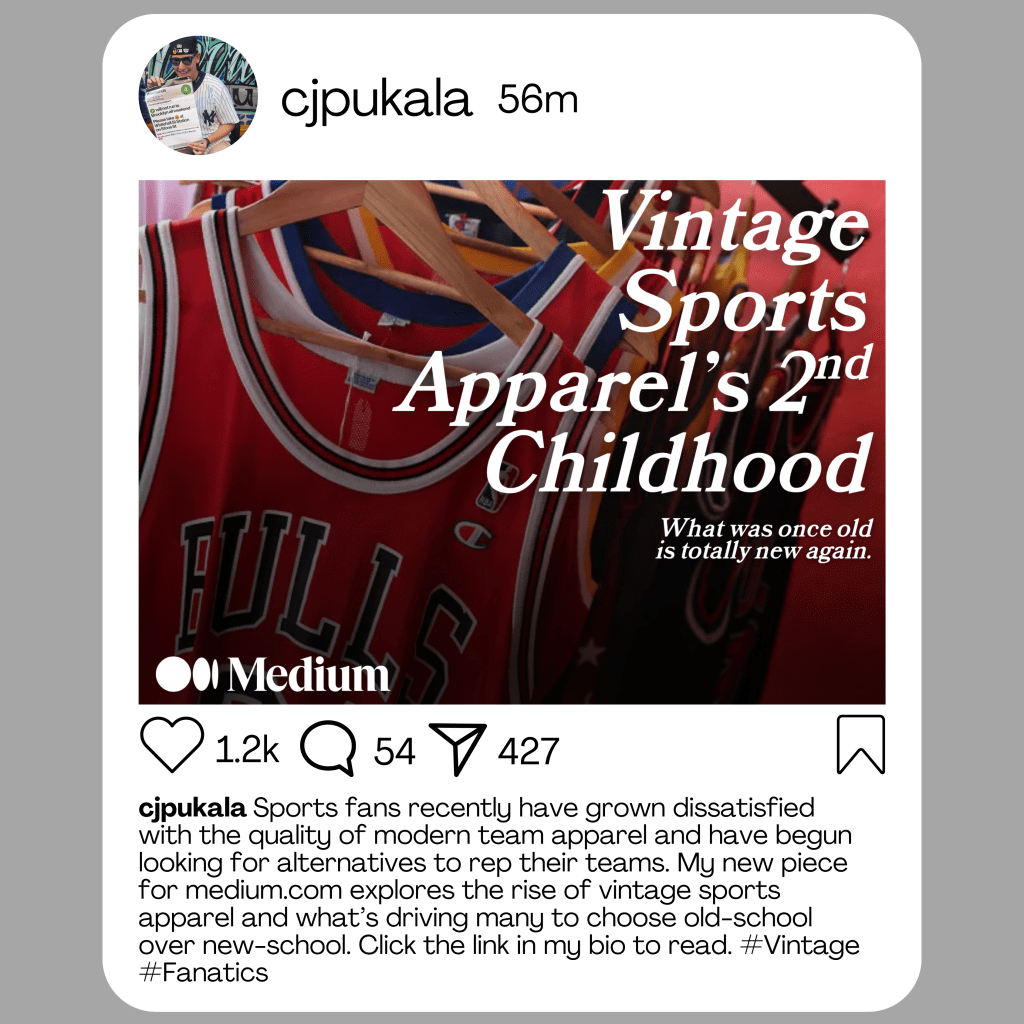
Instagram is more image-focused, so I decided to make the graphic the focus by including the title in big lettering. I did not want to do too much with it; if I included more wording, it would have been too cluttered and too much information for Instagram. Also, I made sure to fit my theme of putting song titles into the title of my article (2nd Childhood by Nas). I wanted to avoid coming up with a basic
X/Twitter
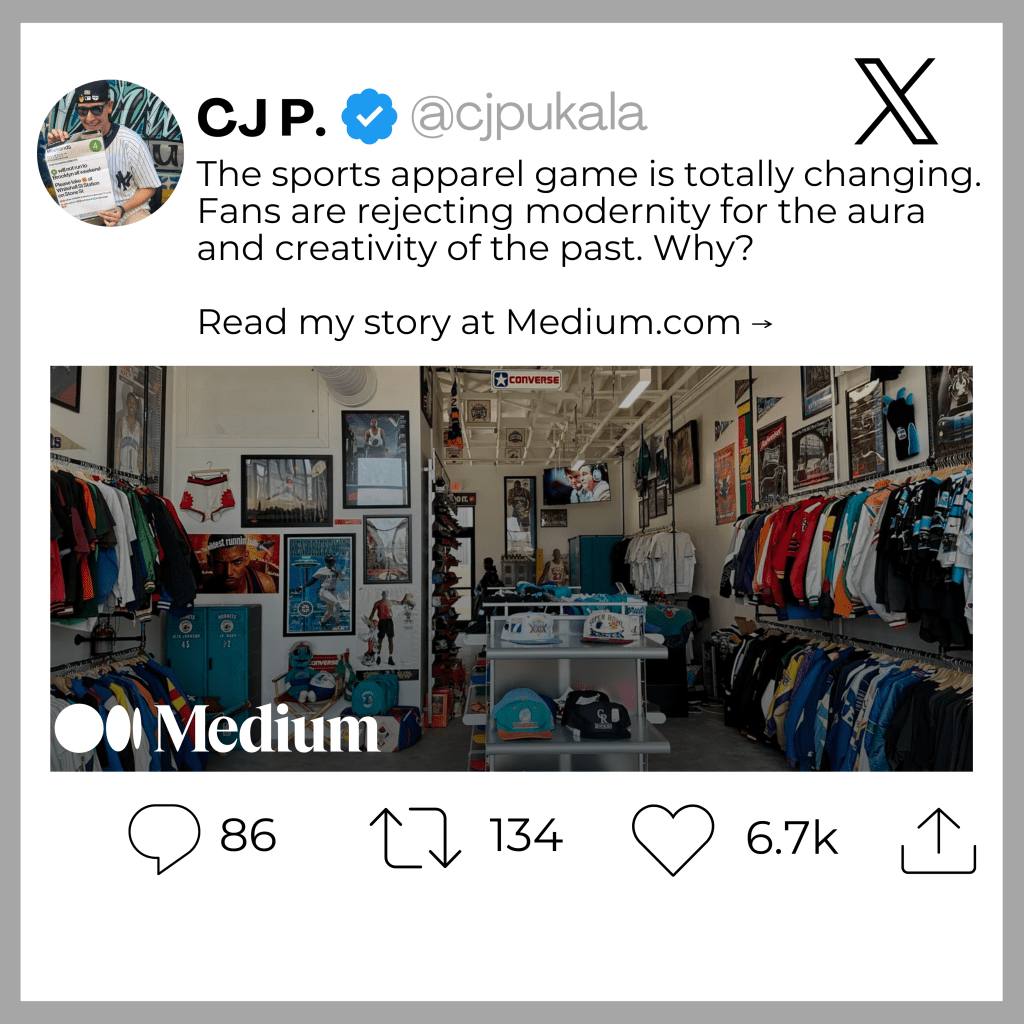
Once again, I avoided a graphic that could have been too confusing or too informative for a reader. I chose a simple image of a vintage sports apparel store because that is something I gravitate towards in my piece. I did not want to give away too much because that might make someone less likely to read the piece.
LinkedIn
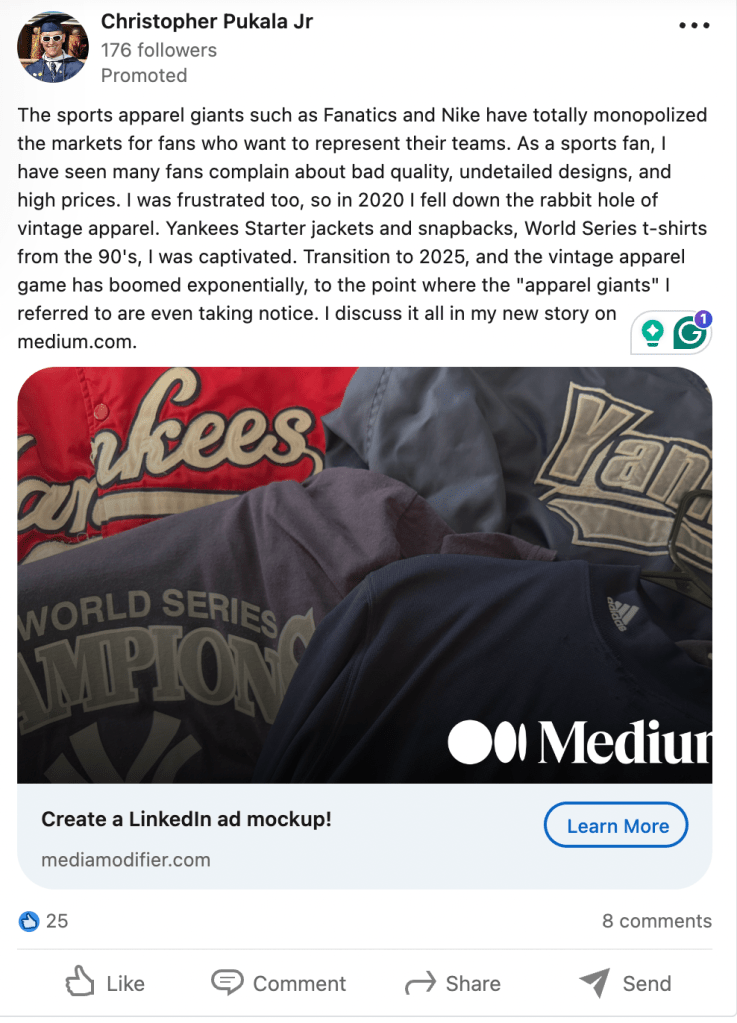
This is the most crucial post because LinkedIn is for professional contacts and for networking. I want to showcase my work in the most professional way possible on here, so I did some research into how others upload their work to LinkedIn. I’m giving a concise synopsis of what I am writing about and included a graphic featuring a photo I took of some vintage pieces from my personal collection.
I wanted to capture a reader’s attention because LinkedIn often features tons of information and visuals from all sorts of people, and sometimes people in my network may have gigantic networks themselves, so my post could get lost in the mix. I sometimes don’t even realize I need to try something that would make me stand out, and hopefully the visual gets people to stop scrolling.
-

Today’s Song: C.R.E.A.M (Cash Rules Everything Around Me) by: The Wu-Tang Clan (1993)
This week, I revisited module three, specifically the essay Bill Gates wrote back in 1996. A quote from it really stood out because it was true.
“Content is where I expect much of the real money will be made on the Internet,” said Gates in his essay.
Gates said that almost 30 years ago, and now, as we approach 2026, so much money is being made on the internet.
Tons of online creators have gained fame, especially over the last decade, and have made tons of money through this. Sponsorship and advertising deals also add to the pile, you know the deal. Online content creation has become a gateway to stardom for many, especially in specific, niche areas of the internet where people seek particular content. Cash is ruling the content creation sphere.
In the Gates essay, he predicts the internet will become a place where “deep and extremely up-to-date information that [readers] can explore at will”. This also turned out to be true, as the internet is constantly refreshed with new information every second. It rarely costs any money at all to post anything on the internet anyway, and the key is to post something that can distinguish you from the rest of the gigantic sea of content on the internet.
The personalities that you see the most in specific areas of the internet, like let’s say football content for example, you find some who seem to be “pioneers” in those specific areas. The Pat McAfee shows of the world for example have revolutionized the football side of the internet, and many flocked to his content because it was something new and refreshing.
As someone like me, this concept stood out because in the past, I have struggled to put out content I believed was meaningful. Whether it was something on Instagram or an article for a class, there have been many times when I went through the motions and didn’t produce meaningful content. Sometimes my content lacks personality, and I just play it safe.
There have been many times when I have produced meaningful content that I actually put time and effort into. I usually feel good about those projects, especially when I put my heart and energy into them. And I hope that consumers feel my heart and passion through whatever content I produce as well.
Who knows, at some point the Cash may be Ruling Everything Around Me regarding my online content. Fun to dream!
-

Note: This article was generated by ChatGPT, an artificial intelligence (AI) chatbot.
Gary Vaynerchuk’s article “Content is King, but Context is God” hits on a truth that every creator, marketer, and even sports fan with a social media account should absorb — great content means nothing if it doesn’t fit the platform or the audience consuming it.
Vaynerchuk argues that too many people obsess over making “great content” without considering where it’s being shared or who it’s for. The same video that crushes on TikTok might flop on Instagram or LinkedIn — not because it’s bad, but because it’s out of context. “You have to respect the platform and audience,” he says, and that simple idea separates brands that thrive from those that fade into the scroll.
Think about it: when fans hop on Instagram, they’re not there for a long lecture about your brand or a cluttered promo post. They want quick, eye-catching visuals that fit the rhythm of their feed. On X (Twitter), it’s about wit and timing. On YouTube, it’s storytelling. Each platform has its own language, and successful creators learn to speak them fluently.
Vaynerchuk’s philosophy mirrors what great coaches do — they don’t force every player into the same system; they adjust their strategy based on the game and the opponent. In the same way, every post, tweet, or video should be tailored for the “game” it’s playing in.
For content creators, that means taking time to understand how people behave on each platform. If you’re running an Instagram page that mixes NYC culture with sports fandom, for example, you might post subway shots leading to Yankee Stadium on Reels, while saving longer, reflective fan stories for a blog or YouTube video. Both pieces are valuable, but their power comes from being placed in the right context.
At its core, Gary Vee’s message is about empathy — knowing your audience deeply enough to meet them where they are. Content might get you noticed, but context keeps people coming back. In a world overloaded with posts and promotions, understanding the mindset of your audience isn’t just good strategy — it’s the key to real connection.
-
Today’s Song: On To The Next One– Jay-Z & Swizz Beats (2009)
I met Gary Vaynerchuk (Gary Vee) back in 2021. I have always been a fan of his content; we share the same rooting interests for sports. I still hope that he buys the Jets one day. He would make a great owner. Anyway, as I was walking out of my first Knicks game, I ran into him and snapped a photo together. It was pretty cool.
In this week’s module, I came across the article by Gary titled “Content Is King, but Context Is God.” The title intrigued me off the bat as a journalist and someone who enjoys his content. So I gave it a read, and I came across a few themes and ideas that jumped out at me as someone aspiring to land somewhere within the content creation realm.
His section about making sure ot not to interrupt the experience of the reader, viewer, scroller, etc, stood out the most to me. When Gary mentioned he got a pop-up ad on the ESPN app for Acura, he tried to click it away. When he did that, it still took him to the Acura website. He said that his “experience was sold back to Acura”.
I am someone who uses the ESPN app, for example, just to check a quick score of a game, like Vee was alluding to. There are many people out there, just like Gary, who have a fast experience in the app.
In the article, Vee noted that you need to capture the viewer’s attention, as they may form a quick impression of the app based on what they see in a short time. If someone wants to see the Lions game score or something, and they are greeted with an Acura ad and swipe out of the app because they get frustrated by it, then ESPN loses out.
Individual content creators, companies, and apps need to provide consumers with an uninterrupted, engaging experience that lets them get what they want. It’s a dog-eat-dog world in the content sphere nowadays, and if people don’t like their content, well they’ll just be going On To The Next One
*This article was not written with the help of Artificial Intelligence (AI)
-

Today’s Song: All About U by Tupac Shakur (1996)
Reading Zinsser’s On Writing Well, especially Chapter 5, got me thinking a lot about this idea of “audience.” He says something that sounds like a total contradiction that we should always write for ourselves, but also make sure not to lose the reader.
Zinsser’s basically saying there are two sides to writing: craft and attitude. Craft is about the technical stuff — being clear, organized, and making sure readers don’t get lost halfway through a sentence. That part’s for them. But attitude is about your energy, your honesty, your personality. When I read articles, I obviously look for a clear and organized piece that keeps me intrigued, but at the same time, combining that knowledge with fun information, energy, and a personal spin on it.
I like how he says if something makes you laugh or feels real while you’re writing it, put it in. I’ve noticed that’s when my writing feels strongest — when I’m not overthinking whether people will “get it” or if it sounds too casual. It’s the same thing I’ve noticed working on creative stuff like my Yankees instagram page. Whenever my buddy Brandon and I try too hard to post something we think people want to see, such as informative graphics with data, it usually falls flat. But when we post something that just feels natural, something we genuinely believe is incredible like a video from the stadium… that’s what people actually connect with. I see writing in the same kind of way.
What I really like about Zinsser’s approach is that he doesn’t tell writers to chase approval. He’s basically saying, if you’re genuine, the right readers will stick with you. That’s something I’ve been trying to apply to my own writing, which is not forcing a voice and just letting my story come naturally.
So yeah, maybe it sounds like a paradox on paper, but Zinsser’s point is actually pretty simple: write for yourself, but respect your reader. Be clear, be real, and have fun with it. If you enjoy what you’re writing, chances are someone else will too. Even if they don’t like it, who cares? You do you. I live by that phrase.
-
*Something I plan on doing in each article is drawing each title from some of my favorite song titles. Today’s Song: Who I Am by The Diplomats (2003)
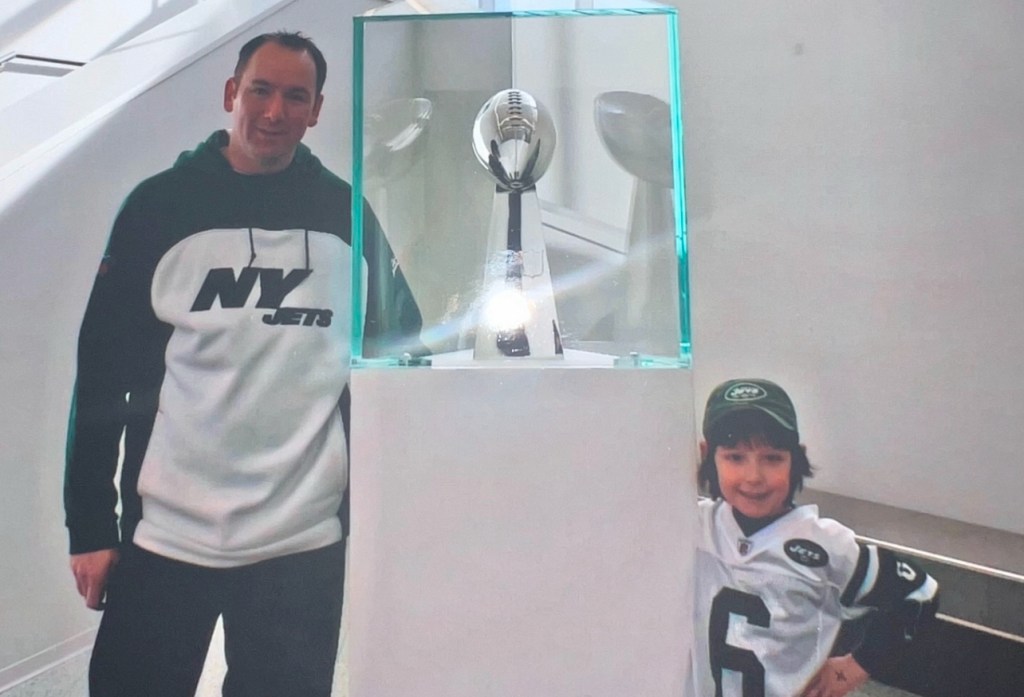
CJ Pukala was born and raised on Staten Island, New York, a place where loyalty to the city’s sports teams runs deep and every game feels larger than life. Growing up in the heart of New York’s passionate sports culture, CJ’s life has been shaped by his devotion to the Yankees, Knicks, Jets, and Devils. His earliest memories are filled with the sounds and excitement (and frustration) of watching games with his father, who passed down his own love for the Yankees and Jets the moment CJ was born, and the loud sounds of MetLife Stadium in its early days.
Over the years, CJ’s connection to sports evolved from being just a fan to seeing them as a career path. For the past four years, he has attended more than 50 Yankees games each season with the Bleacher Creatures. This life-changing experience has not only taught him valuable life lessons but has also deepened his understanding of how sports connect people across backgrounds and generations.
The world-famous Creatures totally transformed his teenage years, and now beyond into his twenties. It was a whirlwind he never expected to end up in, and he swears he was put in that spot for a reason. The amount of baseball stories he can tell from his own experiences and the ones from others that have been recalled is off the charts. So many amazing stories —he can go on for hours.
Whether it’s celebrating a walk-off home run in The Bronx by jumping from the bleachers or sitting in ten degrees at MetLife Stadium, cheering for the Jets, CJ has experienced firsthand the emotional power of sports and the storytelling that surrounds them through multiple group settings and individual experiences.
CJ’s academic and professional goals center on working in sports media and communications. He is passionate about finding ways to share the energy, emotion, and community of New York sports through creative, interactive platforms. Over the years, he has managed sports- and pop-culture-related Instagram accounts. Through this, he has learned more about graphic design, content production, and photography to tell stories. CJ could see himself becoming a graphic designer or a photographer for one of his favorite teams after graduating. His interest in interactive media stems from how digital storytelling through podcasts, social media, photography work, and visual content can build stronger fan connections and bring.
There are stories behind everything, and sports mean more than life to some, especially CJ. He hopes to one day contribute to the media side of one of his favorite teams, helping fans feel the same sense of belonging he’s always felt in the stands, because he believes that showcasing the passion and emotion sports bring is often overlooked and deserves more focus.
CJ’s favorite interactive media projects often revolve around fan engagement—whether that’s creating content that captures the spirit of Yankee Stadium or exploring how social media can enhance the fan experience. To him, interactive media is not just about communication; it’s about connection.
CJ wants to invite people into the world that has defined so much of who he is and truly changed his life as a lifelong New Yorker, a dedicated fan, and a future professional in the sports communication field. His audience can expect authenticity, passion, and a deep appreciation for the ways media and sports bring people together.
 CJ Pukala